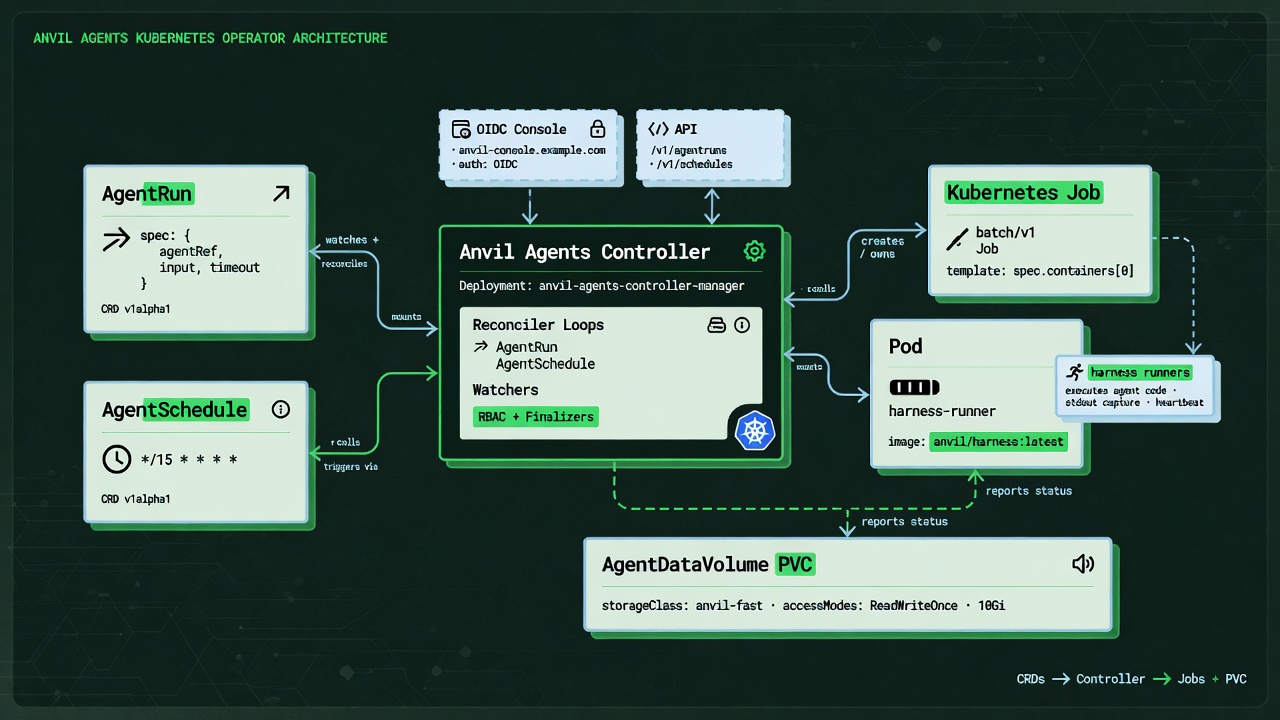
Architecture
Anvil Agents separates desired run policy from harness implementation. The
controller resolves a run, materializes immutable payload files in a ConfigMap,
creates one Kubernetes Job, and projects Job, Pod, log, and structured report
state back onto the AgentRun.
Control Loop
- A user or
AgentSchedulecreates anAgentRun. - The controller resolves its namespace-local
AgentRunProfile,AgentHarnessProfile, orderedAgentSkillSetandAgentToolSetrefs, and local overrides. - It validates backend, Secret, storage, and optional ExternalSecret refs.
- It writes
prompt.md,source.json, skill files, and tool setup scripts, then records composition and payload digests. - It creates exactly one Job using the selected backend image and runner ServiceAccount.
- The selected built-in adapter prepares configured source and bootstraps tools; a custom harness implements the same parts it needs. The harness then performs the prompt and emits structured status records.
- The controller records terminal status and optionally archives it.
A controller restart observes existing children. It does not replace a Job
because a connection was lost. Composition evidence and resolved data volumes
are recoverable from the Job if a crash occurs before the status patch.
Requested Job TTL is enabled only after terminal run status is durable.
Terminal runs are append-only execution records; a new attempt requires a new
AgentRun.
Distributed And Multi-Harness
Each AgentRun selects one of codex, openCode, hermesAgent, openClaw,
grokBuild, piAgent, or custom. The built-in adapters share the same mounted payload,
tool setup, tool verification, environment, and structured-status contract.
Provider-native model and authentication fields remain adapter-specific.
Kubernetes can schedule runs across nodes. AgentSchedule.runTemplates can
rotate independent work through different profiles and harnesses. Allow and
Queue can make multiple runs active, subject to schedule and application-scope
limits.
This is a horizontal workload model. Large builds, test suites, security
passes, indexing, and other expensive tools can be expressed as independent
runs and placed across the cluster instead of sharing one workstation.
AgentHarnessProfile resource requests give the scheduler the information it
needs, while node selectors, affinity, and tolerations route workload classes
to CPU, memory, accelerator, or storage-local node pools. The same role and
skill sets can select a different execution envelope without copying policy.
The normal Kubernetes scheduler can bin-pack or spread those independent Jobs
across eligible workers.
One run still creates one Pod on one node. Scaling across machines means
creating concurrent independent runs; it does not make a single harness
process distributed. Schedule concurrency, application-level
AgentRunControl, namespace quota, cluster capacity, and volume access modes
all bound the effective parallelism. Provider quotas, API rate limits, and
external-service capacity can impose additional ceilings even when worker
machines remain available. See
Distributed Workloads for an operational model.
These runs do not share process memory or a live conversation. subagents
describes personas or delegated passes to the selected harness; it does not
cause the controller to create child Jobs. Durable coordination requires an
explicit API, Git repository, message bus, database, or AgentDataVolume.
Composition Boundaries
An AgentRunProfile owns why and where a role operates. An
AgentHarnessProfile owns how one provider runtime executes, including its
image, workload identity, credentials, storage, placement, and limits. An
AgentSkillSet owns reusable backend-neutral instruction packs and optional
delegated personas. AgentToolSet owns setup and verification contracts for
external tools whose lifecycle is independent from those instructions.
The split allows the same knowledge or review policy and external client to run through Codex, OpenCode, Pi, or a custom harness without copying them. Skill and tool sets cannot select a Secret, ServiceAccount, image, or volume, so choosing one never silently grants runtime identity. Tool setup scripts still execute code, so their authors remain a code-execution authority. See Agent Composition for the exact merge and override rules.
Policy Boundaries
- Kubernetes RBAC decides who may create and edit control-plane resources.
- The run's ServiceAccount and credentials decide what its Job may access.
AgentRunControlpauses launches or narrows concurrency; it is not an authorization system.- A harness image turns prompt intent into actions. The controller does not reinterpret provider-native tool calls.
- The optional public API is read-only. It never creates or approves runs.
applicationRef.name and applicationTargetRef.name are opaque strings used
for grouping, controls, and context. They do not cause another Kubernetes API
lookup. Application names used by AgentRunControl must be cluster-globally
unique between administrative tenants in v1alpha1.
Extension Boundary
Use a built-in runner when its provider contract fits. Use custom for an
existing agent image or an internal harness. Add external clients through an
AgentToolSet, teach roles when to use them through an AgentSkillSet,
provide identities through an AgentHarnessProfile, and expose narrowly
authorized service APIs. Keep provider-native semantics in
harness profiles and product policy in run profiles rather than adding either
to the controller core.
Applications connect adverse events through the immutable AdverseSignal
contract or an administrator-owned structured GVK watch. Both boundaries use
generic references and unstructured status; the controller never imports the
consumer's API. Reporters provide evidence only. The destination
AdverseSituation remains the authority boundary that selects whether and how
an agent responder may run.